Safe early discharge depends on more than having small incisions. You need the diagnosis confirmed, the appendix removed with secure control of its blood supply and base, and a recovery assessment that accounts for perforation, abscess, pain, nausea and infection risk.
Key takeaways
- CT or ultrasound can confirm appendicitis and identify perforation or an abscess.
- Laparoscopic appendectomy uses small incisions, a camera and sealed appendix removal.
- Same-day discharge depends on stable vital signs, controlled pain and tolerated fluids.
- Worsening pain, fever, vomiting or wound discharge after discharge requires medical review.
Which tests show whether appendicitis needs urgent surgery?
Urgent surgery is considered when the pattern of symptoms, examination and test results supports appendicitis diagnosis, especially with worsening right-lower-abdominal pain. Pain that begins near the navel and moves right, loss of appetite, nausea, vomiting or fever strengthens suspicion, but none proves appendicitis alone.
A clinician checks tenderness, guarding, rebound pain, abdominal rigidity, pulse, blood pressure and temperature. Severe constant pain, a hard or swollen abdomen, fainting, confusion, repeated vomiting, or marked weakness requires emergency assessment rather than a routine appointment. These signs can indicate perforation, spreading infection or sepsis.
| Assessment | What it can show | How it affects the decision |
|---|---|---|
| Complete blood count | Raised white-cell count, especially neutrophils | Supports infection but cannot confirm appendicitis |
| C-reactive protein test (CRP) | The intensity and duration of inflammation | A high or rising result increases concern for complicated disease |
| Urine test and pregnancy test | Urinary causes or pregnancy-related considerations | Helps avoid missing another diagnosis and guides imaging |
| Ultrasound or CT scan | An enlarged appendix, appendicolith, perforation, abscess or another cause | Clarifies whether laparoscopic removal is suitable and how urgently to act |
No single blood test rules appendicitis in or out. If examination and results disagree, clinicians may use observation, repeat examination or imaging; an abscess can require drainage and antibiotics before surgery, while perforation or sepsis demands urgent hospital treatment and source control.
What happens during a laparoscopic appendectomy?
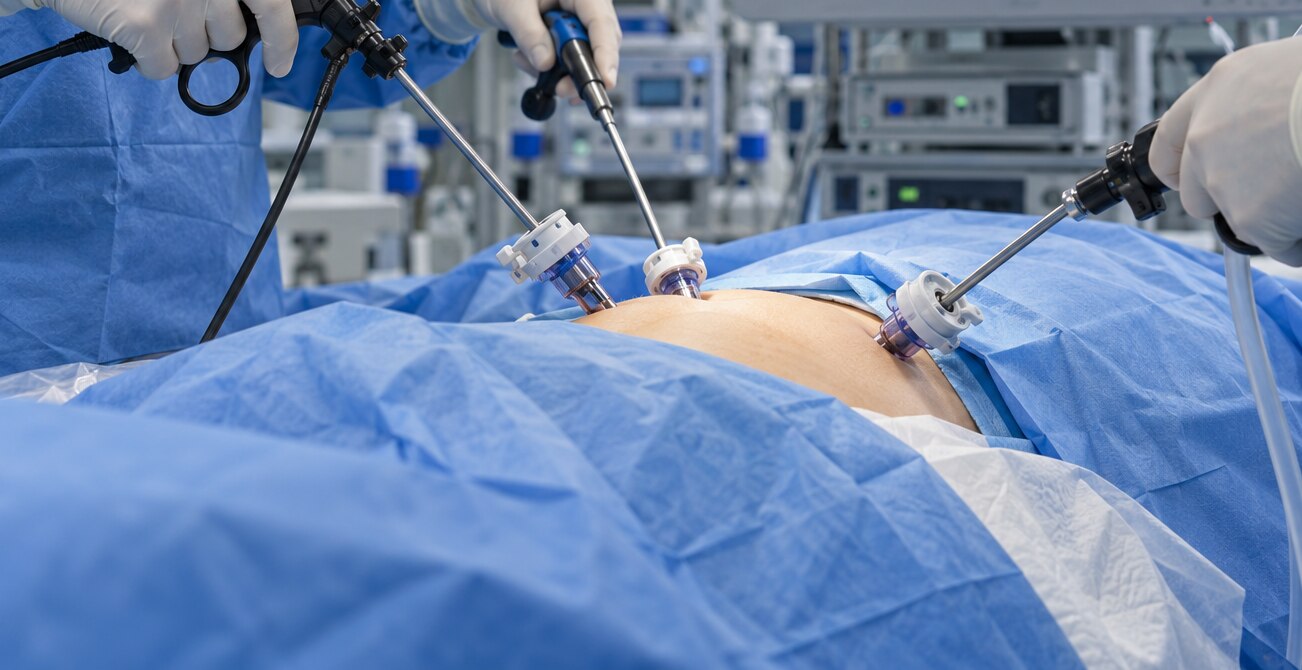
The operation begins with general anaesthesia, so you are unconscious and your abdominal muscles are relaxed. The surgeon makes a small incision near the navel, places an umbilical camera port, and fills the abdomen with carbon dioxide to create working space.
The laparoscopic appendectomy procedure then follows a controlled sequence:
- One or two additional working ports are inserted through small incisions. Their positions are adjusted to the appendix’s location and the patient’s anatomy.
- The camera surveys the abdomen instead of assuming that right-sided pain proves appendicitis. The surgeon identifies the appendix and caecum and looks for another cause of the symptoms.
- The surgeon separates the appendix, seals or divides the appendicular artery, and closes the appendix at its base with a loop, clips, sutures or a stapling device.
- The appendix is placed in a retrieval bag and removed through a port incision. The bag limits contact between an infected specimen and the wound but does not guarantee that infection will not occur.
- Any pus or contaminated fluid is removed, and the area receives a washout when needed. The surgeon checks the artery, appendix base and surrounding tissues for bleeding before withdrawing the instruments and closing the incisions.
If the appendix is hard to reach, the anatomy is unclear or bleeding cannot be controlled safely, the surgeon can add a port, enlarge an incision or convert to open surgery. That decision protects you; it is not automatically a complication or failure.
How does the surgeon adapt the operation to the appendix and the infection?
A clean, non-perforated appendix usually permits a straightforward laparoscopic removal and secure stump closure. A gangrenous appendix or perforated appendix demands careful handling because spilled infection can cause peritonitis, bleeding or an abscess.
An appendicular abscess is usually treated with antibiotics and, when accessible and necessary, image-guided drainage before or instead of immediate surgery. An appendicular mass may be managed initially with antibiotics and observation because forcing dissection through dense inflamed tissue can injure the bowel. The timing of later surgery depends on symptoms, imaging and local practice.
The appendix may lie behind the caecum, beneath the ileum or in the pelvis. The surgeon may add a port, change the camera angle or enlarge an incision to find it safely. At a consultation, Dr Mayur Porwal 08042753618 can explain which approach fits the scan and operative findings.
The appendiceal base must close securely without narrowing or injuring the caecum:
- Endoloops or clips often suit a thin, clearly defined base.
- Intracorporeal sutures help when tissue is awkward or a clip does not hold securely.
- A stapler can control a broad, friable or severely inflamed base, but it costs more and may remove extra caecal tissue.
For perforation, abscess or diffuse contamination, antibiotics continue after source control; courses are commonly limited to 24 hours through 3–5 days according to recovery and local protocol. Conversion to open surgery is a safety decision when bleeding persists, adhesions or inflammation obscure anatomy, or the appendix cannot be identified safely.
Related service
Laparoscopic appendix surgery Laparoscopic appendectomy is a minimally invasive surgery to remove an inflamed or infected appendix, usually due to appendicitis. View service → |
What determines whether you leave the hospital the same day?
Same-day discharge after appendectomy is reasonable only when recovery is uncomplicated and home care is dependable. A candidate should have:
- Stable blood pressure, pulse, breathing and temperature
- Pain and nausea controlled with oral medicines
- Ability to drink fluids without vomiting
- Ability to walk safely and pass urine
- No concerning bleeding or significant abdominal contamination
- No severe medical condition requiring monitoring
- A responsible adult and rapid access to emergency review
Small incisions do not guarantee a short hospital stay. Perforation, diffuse peritonitis, sepsis, uncontrolled pain, persistent vomiting or a slow return of bowel function calls for observation or a longer admission. Significant heart, lung, kidney or blood-sugar problems also lower the threshold for monitoring, even after a technically successful laparoscopic operation.
A contained infection may require intravenous antibiotics, and an ileus may prevent safe eating and discharge. A postoperative drain is not routine; the surgeon may use one for a residual collection or concern about leakage, which usually means closer observation. Antibiotics continue after perforation or abscess until clinical recovery supports stopping them.
Before leaving, you need clear instructions for fever, worsening pain, swelling or repeated vomiting and a practical route back to the hospital. If emergency review is difficult, same-day discharge is unsafe even when your vital signs and incisions look satisfactory.
Which recovery symptoms require medical review after discharge?
Most people need a recovery check, not a scan, after an uncomplicated laparoscopic appendectomy. During appendectomy recovery, pain and nausea should improve, you should walk, urinate, drink fluids and keep medicines down, and the small wounds should remain clean without spreading redness or pus.
A postoperative CT scan is unnecessary when these checks are satisfactory and recovery is steadily improving. Scanning everyone can find harmless incidental changes and trigger unnecessary procedures. Doctors reserve imaging for persistent or returning fever, worsening pain, abnormal blood-test inflammation, or concern about a collection, stump leak, bowel injury or another diagnosis.
Seek medical review urgently if you develop any of the following. Do not dismiss them as normal recovery, particularly after perforated appendicitis, which carries a higher risk of an intra-abdominal abscess.
| Symptom | Why it matters | What to do |
|---|---|---|
| Fever after appendectomy that persists or returns | Possible abscess, leak or continuing infection | Contact the surgical team urgently |
| Worsening abdominal pain or increasing swelling | Possible abscess, bowel injury, obstruction or leak | Seek same-day assessment |
| Repeated vomiting or inability to drink | Dehydration, obstruction or worsening infection | Obtain urgent medical care |
| Fainting, confusion or marked weakness | Possible sepsis, bleeding or severe dehydration | Call emergency services |
| Increasing wound redness, pus or bleeding | Wound infection or bleeding | Arrange prompt review |
A clinician may examine you, repeat blood tests and order CT only when the findings justify it. Antibiotics alone are not a safe substitute for assessing a suspected complication.
Frequently asked questions
Which tests show whether appendicitis needs urgent surgery?
Doctors combine the pain pattern and abdominal examination with blood tests and imaging. Ultrasound or CT can show an inflamed appendix, rupture, abscess or another cause of pain.
What happens during a laparoscopic appendectomy?
The surgeon makes small abdominal incisions, inflates the abdomen with carbon dioxide, guides a camera and instruments inside, seals the appendix base and removes the appendix.
How does the surgeon adapt the operation to the appendix and the infection?
The surgeon changes the approach when the appendix has perforated, an abscess is present, bleeding occurs or nearby bowel is inflamed. Treatment can include washing out infection, placing a drain or converting to open surgery.
What determines whether you leave the hospital the same day?
You need stable vital signs, alertness, controlled pain, no concerning bleeding or infection, the ability to drink and urinate, and safe movement after anaesthesia.
Which recovery symptoms require medical review after discharge?
Seek medical review for worsening abdominal pain, persistent vomiting, fever, increasing abdominal swelling, redness or pus at an incision, heavy bleeding, breathing difficulty or inability to pass urine.