A hernia that becomes painful, firm, discoloured or impossible to push back can trap bowel and cut off its blood supply, turning a planned repair into an emergency. You will learn how surgeons assess that risk, when observation is reasonable, what repair and mesh actually involve, and how to choose an approach that limits recurrence and recovery problems.
Key takeaways
- Seek emergency care for severe pain, vomiting, or a firm discoloured bulge.
- Plan repair for a painful, enlarging, or activity-limiting hernia.
- Mesh reinforcement strengthens weak tissue and lowers recurrence risk.
- Follow lifting, wound-care, coughing, and constipation advice after surgery.
When a hernia becomes an emergency
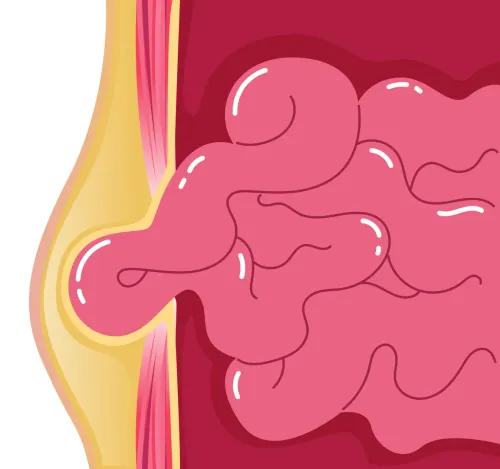
A reducible hernia is a bulge that returns into the abdomen when you lie down or with gentle pressure, then reappears when you stand or strain. An incarcerated hernia stays outside and cannot be pushed back.
A painful irreducible lump needs urgent medical assessment because trapped bowel can become obstructed; do not repeatedly force it back.
A strangulated hernia is an incarcerated hernia whose blood supply has been cut off. Seek emergency care immediately for:
- Sudden or worsening severe pain or tenderness
- A firm lump with red, purple, dusky or black skin
- Vomiting, abdominal swelling, or inability to pass stool or gas
- Fever, rapid heartbeat, faintness or marked weakness
These symptoms can appear together or separately. Strangulation can destroy trapped bowel, leading to perforation, peritonitis and sepsis. Emergency surgery may release the constriction, check bowel blood flow, remove nonviable bowel and repair the defect. If bowel contents have contaminated the area, the surgeon may modify or delay mesh placement.
A reducible hernia can usually be assessed for elective repair, while an incarcerated hernia needs prompt surgical review. A strangulated hernia requires immediate treatment, not routine scheduling. Only an examination, and sometimes imaging, can confirm the diagnosis.
When to watch a hernia and when to plan repair
A reducible, minimally symptomatic inguinal hernia in a man can often be observed rather than repaired immediately. A hernia examination checks the lump while you stand, cough and lie down, assessing its size, tenderness, reducibility and effect on movement. Symptoms commonly increase over time, leading many patients to choose elective repair.
- Choose watchful waiting inguinal hernia management when the bulge reduces easily, discomfort is minimal, daily activities remain normal and you can attend follow-up.
- Plan elective repair when pain limits walking, lifting or work; the lump is enlarging; reduction becomes difficult; or the diagnosis is uncertain.
- Do not use observation as the default for a woman’s groin hernia or a suspected femoral hernia, because femoral defects are easier to miss and carry a higher risk of incarceration.
A hernia ultrasound adds value when examination is inconclusive, especially for an occult groin or femoral hernia. Dynamic scanning during standing or straining can show tissue moving through the defect, while also identifying lymph nodes or other causes of a lump.
A CT scan for hernia maps the defect, its contents and surrounding abdominal wall, which helps with large, recurrent, incisional or multiple hernias and operative planning. Pain with an irreducible lump, vomiting, abdominal distension or inability to pass stool or gas requires urgent assessment, not elective scheduling.
How the repair prevents recurrence and bowel complications
Returning the bulge is only the first step. Surgeons perform hernia defect closure to narrow or eliminate the opening, then reinforce the repair so abdominal pressure does not reopen it. Mesh hernia repair spreads tension across stronger tissue instead of relying on stitches alone.
| Hernia type | Usual repair decision | How it limits complications |
|---|---|---|
| Groin | Preperitoneal mesh through TAPP or TEP, or an open mesh repair | Reinforces the entire weak area and lowers recurrence; tissue repair suits selected patients who avoid permanent mesh or have contamination |
| Umbilical or epigastric | Suture closure for a carefully selected tiny defect; mesh for many larger or higher-risk defects | Reduces suture pull-through and recurrence; “small” does not mean risk-free |
| Midline incisional | Retromuscular mesh placement or preperitoneal mesh when feasible | Keeps mesh away from bowel, reducing concerns about adhesions, migration, injury and fistula; large or recurrent defects may need component separation |
| Hiatal | Crural closure with stomach and oesophagus repositioning, often combined with an anti-reflux operation | Treats the anatomy causing reflux or obstruction; routine hiatal mesh remains controversial because erosion can injure the oesophagus or stomach |
A large, recurrent or “loss-of-domain” abdominal-wall hernia may need component separation or another complex reconstruction to close the fascia without dangerous tension. If bowel is strangulated, the surgeon releases the constriction, checks its blood supply and removes nonviable bowel; contamination can make immediate permanent mesh unsafe.
Open, laparoscopic and robotic repair: how the choices differ
The choice depends on hernia location, size, previous operations, anaesthesia risk and the surgeon’s experience—not on whether one technique is simply “newer.”
| Option | What it involves | Where it fits |
|---|---|---|
| Open hernia repair | One incision directly over or near the defect; local, regional or general anaesthesia may be possible | Groin, umbilical, ventral and incisional hernias, especially when avoiding entry into the abdomen matters |
| Laparoscopic hernia repair | Small abdominal incisions and a camera; TAPP repair enters the abdomen before opening the peritoneum, while TEP repair stays outside the abdominal cavity | Bilateral groin hernias, recurrence after anterior open repair, and selected ventral or incisional hernias |
| Robotic hernia surgery | Robotic instruments control the same minimally invasive repair through small ports; it is not a different type of mesh | Selected complex ventral or incisional defects where precise dissection or abdominal-wall reconstruction is useful |
For groin hernias, laparo-endoscopic repair can reduce early wound pain and suit bilateral disease, but it requires general anaesthesia and specialist expertise. Open repair avoids abdominal entry. Women with groin hernias need prompt assessment because femoral hernias carry a higher emergency risk.
Minimally invasive repair is unsuitable when you cannot safely tolerate general anaesthesia, severe adhesions or contamination make access hazardous, or the defect requires reconstruction that cannot be completed safely through ports. Large or recurrent incisional hernias often need retromuscular or preperitoneal mesh rather than mesh against bowel.
Dr Mayur Porwal 08042753618 can help weigh prior scars, defect anatomy, anaesthesia risk and the added cost of robotic equipment before selecting an approach.
Related services
Laparoscopic hernia surgery Laparoscopic hernia surgery is a minimally invasive procedure used to repair various types of hernias, especially inguinal, umbilical, incisional,... View service → |
hernia and gallbladder surgery hernia and gallbladder surgery Hernia surgery is a procedure performed to repair a hernia, which is a condition where an internal organ or tissue bulges through a weak spot in the... View service → |
Reducing complications before and after hernia surgery
Before elective repair, hernia surgery preparation should address smoking, excess weight, diabetes, nutrition, cough and constipation. Smoking and hernia recurrence are linked through impaired tissue oxygenation and coughing; diabetes and wound healing are linked through infection and delayed closure. Do not postpone suspected incarceration or strangulation for optimization.
- Stop smoking before surgery and during recovery.
- Improve blood-glucose control; ask whether a recent HbA1c requires action.
- Correct protein deficiency, anaemia or other nutritional problems.
- Treat a persistent cough and prevent straining from constipation.
- Follow lifting, wound-care and walking instructions; excessive early pressure can disrupt the repair.
A swelling after surgery does not automatically mean recurrence. A seroma is a fluid collection that can feel soft or fluctuant, while abdominal-wall laxity or denervation can create a bulge without a new defect. Examination, ultrasound or CT separates these findings when the diagnosis is unclear.
| Finding | More likely explanation | What to do |
|---|---|---|
| Early soft swelling without fever or worsening pain | Seroma or postoperative oedema | Attend scheduled review; do not puncture it yourself |
| Bulge that changes with position or coughing | Laxity, denervation or recurrence | Arrange examination; ultrasound or CT may be needed |
| Increasing redness, warmth, drainage, fever or severe pain | Hernia surgery complications such as infection or bowel injury | Seek urgent medical assessment |
| Vomiting, abdominal distension, inability to pass stool or gas, or a painful irreducible lump | Obstruction or strangulation | Go to an emergency department immediately |
Chronic pain risk rises with nerve irritation, recurrent repair, excessive mesh fixation and severe preoperative pain; report burning, electric or persistent pain rather than masking it with prolonged self-medication.
Frequently asked questions
When does a hernia become an emergency?
Seek urgent medical care when a bulge cannot be pushed back and you develop severe or worsening pain, vomiting, abdominal swelling, fever, or skin discoloration over the hernia. These signs can indicate bowel obstruction or strangulation.
When should you watch a hernia instead of planning repair?
A small, reducible hernia without pain or activity limits can sometimes be monitored after a surgical assessment. Arrange planned repair when it causes pain, enlarges, restricts activity, or becomes difficult to reduce.
How does hernia surgery prevent recurrence and bowel complications?
Repair returns protruding tissue to the abdomen and closes or reinforces the abdominal-wall defect. Mesh reinforcement reduces tension on the repair, while prompt treatment of an incarcerated or strangulated hernia helps protect the bowel.
How do open, laparoscopic and robotic hernia repairs differ?
Open repair uses one incision over the hernia. Laparoscopic repair uses small incisions and a camera, while robotic repair uses similar small incisions with instrument controls operated by the surgeon. The hernia type, size, location, previous operations, health, and surgeon expertise guide the choice.
How can you reduce complications before and after hernia surgery?
Tell your surgeon about medicines, smoking, diabetes, previous abdominal operations, and constipation. After surgery, follow wound-care and activity instructions, prevent straining, support coughs as advised, and report fever, increasing redness, drainage, worsening pain, vomiting, or inability to pass stool or gas.
Related services
Laparoscopic Ventral hernia surgery Laparoscopic Ventral hernia surgery Laparoscopic ventral hernia repair is a minimally invasive technique to treat ventral hernias—hernias that occur through a weakness in the abdominal... View service → |
Laparoscopic umbilical hernia surgery Laparoscopic umbilical hernia surgery Laparoscopic umbilical hernia repair is a minimally invasive procedure used to treat hernias occurring at or near the belly button (umbilicus), where... View service → |
Laparoscopic inguinal hernia surgery Laparoscopic inguinal hernia surgery Laparoscopic inguinal hernia repair is a minimally invasive procedure used to fix hernias in the groin area, where abdominal contents protrude... View service → |
Abdominal Tumor Surgery An abdominal tumor is an abnormal growth of tissue in the abdominal cavity. View service → |